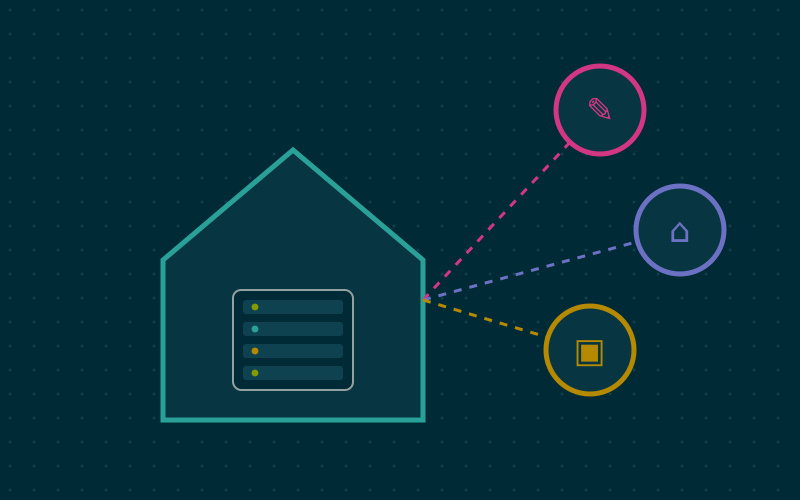
Home Wi-Fi is designed for rooms. As soon as you step into the garden, onto the terrace or into a garage detached from the house, the signal drops quickly: thick external walls, windows with treated glass and distance do the rest. Moving the router or adding an extender indoors is rarely enough. There are two effective solutions: an access point designed for outdoor use, or a wireless bridge when the distance is greater.
Why the signal does not leave the house
External walls are usually the thickest and often contain reinforced concrete. Low-emissivity glass, used in modern windows for thermal insulation, has a thin metallic layer that also attenuates radio waves. An indoor access point near a window may cover the terrace well, but it will hardly reach the end of the garden.
There is also a symmetry problem: a powerful access point can make itself heard by the phone even from a distance, but the phone transmits at lower power and the access point does not hear it as well. The result is a signal that seems present but on which the connection does not work.
Outdoor access points
An outdoor access point is a device designed to live outside: an enclosure resistant to rain, dust and sun, brackets for a pole or wall, power through the network cable. It connects by cable to the home network and broadcasts Wi-Fi over the outdoor area.
The IP protection rating
Resistance to the elements is indicated by the IP code followed by two digits: the first refers to dust, the second to liquids.
| Code | Protection |
|---|---|
| IP54 | Partial dust protection, water splashes from any direction |
| IP65 | Dust-tight, water jets |
| IP66 | Dust-tight, powerful water jets |
| IP67 | Dust-tight, temporary immersion |
For a device exposed to rain, aim for at least IP65. An indoor access point under a canopy may look like a solution, but humidity, condensation and temperature swings damage it quickly.
PoE power
Almost all outdoor access points are powered via PoE (Power over Ethernet): a single cable carries both data and power. You need a PoE switch or a small injector indoors. It is a big convenience, because no outdoor power socket is required. The cable that runs outside should be an outdoor-rated, UV-resistant type, and its entry point into the house should be sealed.
Placement
An outdoor access point performs best mounted high, with a direct view of the area to cover. Some models have omnidirectional antennas, which cover a circle around the device; others have directional antennas, which concentrate the signal in a sector. For a garden in front of the house, a directional model mounted on the façade and facing outwards is often the most effective choice.
Point-to-point wireless bridges
When you need to connect a separate building, such as a garage at the end of the plot, a workshop or an outbuilding, tens or hundreds of metres away, the solution is a wireless bridge. It is a pair of devices with directional antennas, one on the house and one on the remote building, which "see" each other and create a dedicated link. On the far side you connect a switch or an access point, and the remote building becomes part of the home network.
Many home bridges operate in the 5 GHz band; there are also 60 GHz models, very fast over short distances but sensitive to heavy rain and obstacles.
Line of sight
To work well, a wireless bridge needs the two antennas to see each other without obstacles. A clear straight line is not enough, though: radio waves occupy an ellipse-shaped volume around the line, called the Fresnel zone. If trees, roofs or a tall hedge intrude into that volume, the link loses quality. That is why antennas should be mounted as high as possible, above the vegetation.
You should also take tree growth into account: a bridge that works in winter can get worse in spring, when the leaves come back.
Electrical safety and lightning
Devices mounted outdoors, especially in elevated positions, are more exposed to power surges. It is wise to fit surge protection on the network cable where it enters the house and to have an electrician assess the grounding. In my work I have seen indoor switches damaged by a surge that came in through the cable of an outdoor device: a protector costing a few euros would have prevented the failure.
In short
- External walls and low-emissivity glass block much of the signal towards the outside.
- An outdoor access point rated at least IP65 and powered by PoE is the solution for the garden.
- Mount the access point high, with a direct view of the area to cover.
- For separate buildings at a distance, use a point-to-point wireless bridge.
- Keep the Fresnel zone clear and protect outdoor cables from surges.